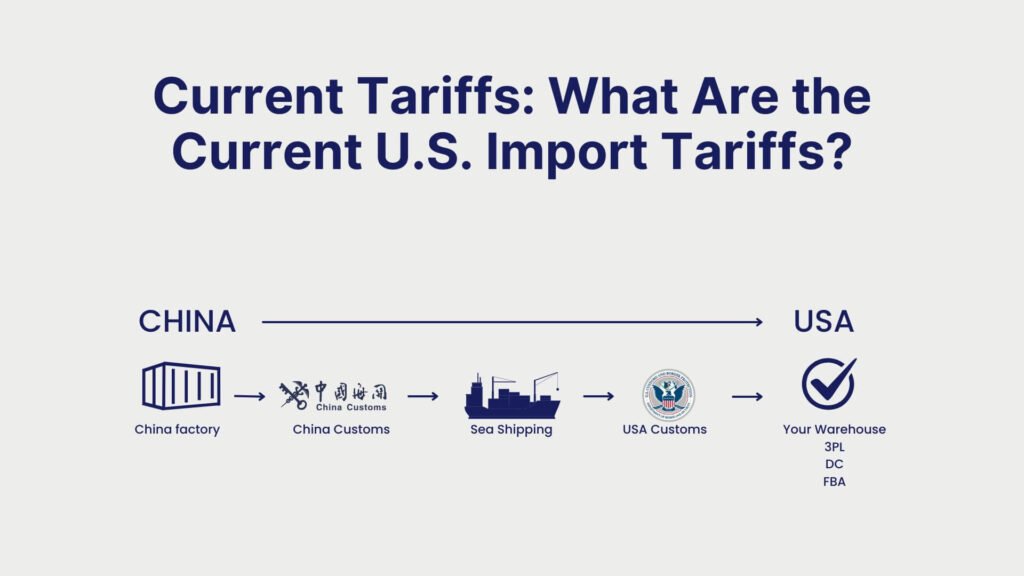
Feeling lost in the maze of U.S. tariffs? Unexpected duties can destroy your profits, making cost forecasting a nightmare. Understanding the current tariff landscape is your first step to control.
U.S. import tariffs in 20251 are a complex mix based on product HS code, country of origin, and specific trade policies. The highest rates typically apply to goods from China under Section 3012 and steel or aluminum products under Section 2323, significantly impacting importers' landed cost4s.
I've spent years helping U.S. importers like you navigate this environment. The rules seem to change constantly, and a small mistake can cost you thousands. But it doesn't have to be a mystery. The key is to break the problem down into manageable pieces. We can look at what the tariffs are, how they affect your bottom line, and what you can do about them. Let’s dive in and get you the clarity you need to import with confidence.
What Are the Current U.S. Import Tariffs in 2025 and Which Products and Countries Are Most Affected?
Are you unsure which tariffs apply to your products? Guessing wrong leads to surprise bills and customs delays, especially for goods from China. Let's pinpoint the key tariffs and who they hit.
U.S. import tariffs in 20251 vary by product classification, country of origin, and trade program eligibility. Importers sourcing from China, steel- and aluminum-producing countries, and select strategic sectors face the highest tariff exposure.
When I talk to importers, the biggest confusion is that there isn't one single "U.S. tariff." It's a layered system. At the base, you have the standard Most-Favored-Nation (MFN) rates5 that apply to goods from most WTO member countries. These are usually low. The real pain for many importers comes from the additional tariffs stacked on top of the MFN rates. I recently helped a client who was importing electronic components from China. He budgeted for the 2% MFN duty but was completely unaware of the extra 25% Section 3012 tariff. That discovery changed his entire profit calculation for the year.
Key Tariff Groups to Watch
The tariffs you need to watch most closely are the ones targeting specific countries and products. They are not the standard duties but are extra taxes imposed for trade policy reasons.
| Country/Product Focus | Tariff Type | Who Is Most Affected? |
|---|---|---|
| China | Section 3012 | Importers of electronics, machinery, apparel, furniture. |
| Global Steel | Section 2323 | Automotive, construction, and industrial equipment importers. |
| Global Aluminum | Section 2323 | Beverage, transportation, and building material importers. |
Understanding which bucket your product falls into is the first critical step.
How Do Section 3012, Section 2323, and Reciprocal Tariffs6 Actually Impact Your Landed Cost and Profit Margin?
Do you see these tariffs as just another line item? They directly inflate your landed cost4, tie up cash, and can make a profitable product suddenly unprofitable. I will show you their true impact.
Section 3012 and 232 tariffs add percentage-based duties on top of standard import rates, directly increasing landed cost4, duty outlay, and inventory value. Reciprocal tariffs further amplify risk by changing rates quickly, making accurate cost forecasting and margin protection difficult without proactive tariff and classification management.
Many importers I work with initially misunderstand how these duties are calculated. They think a 25% tariff is a tax on their profit. The reality is much harsher. The tariff is applied to the total declared value of the goods. Let's look at a simple example.
Calculating the Real Cost
Imagine you're importing a container of widgets from China with a commercial value of $50,000.
- Standard MFN Duty: Let's say it's 3%. That's $1,500.
- Section 3012 Tariff: An additional 25%. That's another $12,500.
- Total Duties: You now owe $14,000, not just $1,500.
This extra $12,500 directly increases your landed cost4. It's cash you have to pay upfront before you can even sell the product. This inflates your inventory value and reduces the cash you have for other parts of your business. Below is a breakdown of the most common punitive tariffs.
| Tariff Type | Applies To | Typical Rate | Who Is Most Affected | Importer Risk |
|---|---|---|---|---|
| Section 3012 | China-origin goods | 7.5%–25% | Retailers, manufacturers, e-commerce | High landed-cost inflation |
| Section 2323 | Steel & aluminum | 10%–25% | Industrial, construction, automotive | Cost volatility, quotas |
| Reciprocal Tariffs6 | Targeted countries | Varies by policy | Strategic industries | Sudden rate changes |
| MFN Tariffs | All WTO countries | Low to moderate | General importers | Classification errors |
| Anti-Dumping / CVD | Specific products | Variable | Price-sensitive imports | Audit & retroactive duties |
Who Sets U.S. Tariff Rates and How Fast Can Import Tariffs Change Without Notice?
Do you feel like the rules on tariffs change overnight? This uncertainty makes long-term planning impossible and puts your supply chain at risk. Let's clarify who pulls the levers and how fast things move.
U.S. tariff rates are set through a combination of congressional authority, presidential trade powers, and agency enforcement by CBP and USTR. Many tariffs can change with little advance notice through executive action, investigations, or trade retaliation, leaving importers exposed if contracts and sourcing plans lack flexibility.
It’s confusing because there isn't one person in charge. Think of it as a team with different roles. I remember the chaos in 2018 when the Section 3012 tariffs were first announced. My phone was ringing constantly with clients asking if their cargo already on the water would be hit with the new tariffs. The answer was yes, and it caused major financial stress for those who weren't prepared. This experience showed how critical it is to understand who can make these decisions and how quickly.
The Key Players in U.S. Tariff Policy
-
Congress: They create the foundation. Congress writes the trade laws and maintains the Harmonized Tariff Schedule (HTS), which is the master list of all standard MFN duty rates. These rates are stable and don't change often.
-
The President & USTR (U.S. Trade Representative): This is where the speed comes from. The executive branch can use existing laws, like Section 3012 and Section 2323, to impose new tariffs quickly in response to trade disputes or national security concerns. These changes can be announced and implemented in a matter of weeks, not years.
-
CBP (U.S. Customs and Border Protection)7: They are the enforcers. CBP is the agency at the port that inspects your cargo, verifies its classification and origin, and collects the duties you owe.
The biggest risk for importers comes from the executive branch's power. A single policy shift can add a 25% cost to your products with very little warning.
How Can Importers Legally Reduce Tariff Exposure Through HS Classification, Country of Origin, and Trade Programs?
Are you paying more in tariffs than you need to? Simply accepting high tariffs without exploring all your legal options means you are leaving money on the table. There are compliant ways to lower your duty bill.
Importers can legally reduce tariff exposure through accurate HS classification8, correct country-of-origin determination, and use of programs such as FTZs, duty drawback, and preferential trade agreements. Small classification or origin errors can trigger unnecessary tariffs, penalties, or audits, making professional compliance review critical.

Many importers feel powerless against tariffs, but you have more control than you think. It's not about finding illegal loopholes; it's about ensuring your customs declarations are 100% accurate and take advantage of all available legal provisions. I worked with an importer, Mark, who brought in home decor items. His supplier in China was using a general HS code for "wooden furniture" that had a 25% Section 3012 tariff. After we reviewed the product specs, we found a more specific HS code for "wooden statuettes" that was not on the Section 3012 list. This one change was perfectly legal and saved him over $50,000 a year.
Three Pillars of Tariff Mitigation
-
Correct HS Classification: This is your number one tool. A product can sometimes be described by several HS codes. Your job, or your broker's job, is to find the single most accurate code. This requires a deep understanding of your product and the HTS. It's not about "shopping" for a low-duty code; it's about finding the correct one, which may happen to have a lower duty.
-
Country of Origin Rules9: This is more complex. Tariffs are based on where a product is made, not just where it ships from. If parts from China are sent to Mexico and "substantially transformed" into a new product, the origin may legally become Mexico. This can be a powerful strategy, but the rules for "substantial transformation" are very strict and require expert legal and customs advice.
-
Trade Programs: The U.S. offers programs like Duty Drawback10, which allows you to claim a refund on duties paid for goods you later export. Foreign Trade Zones (FTZs)11 let you delay or reduce duty payments. These are specialized tools but can offer huge savings for the right business model.
How Should U.S. Importers Prepare Their Supply Chain and Contracts for Ongoing Tariff Volatility?
Does your supply chain feel fragile and exposed to tariff shocks? A single tariff change can derail your operation, causing delays and lost sales. Let's build a more resilient import strategy together.
U.S. importers should manage tariff volatility12 by diversifying sourcing, renegotiating Incoterms13 and pricing clauses, forecasting landed cost4s, and aligning freight and customs partners early. A flexible, compliance-driven supply chain reduces disruption when tariffs change suddenly and protects margins in uncertain trade environments.
In my experience, the importers who thrive during periods of trade uncertainty are the ones who plan for it. They treat tariff risk just like any other business risk. They don't just react to bad news; they build a system that can handle it. During the height of the trade war, our most successful clients were the ones we had worked with to build this kind of flexibility. They had backup suppliers and clear contracts, so they weathered the storm much better than those who had all their eggs in one basket.
Building a Tariff-Resilient Supply Chain
Here are four practical steps you should be taking right now:
-
1. Review Your Contracts & Incoterms13: Look at your purchase orders. Who is responsible for paying a sudden new tariff? If your terms are FOB (Free On Board), that risk is yours. If they are DDP (Delivered Duty Paid), the risk is on your seller. Discuss this openly with your suppliers and make sure your contracts are clear.
-
2. Diversify Your Sourcing: Relying 100% on a single country, especially one targeted by tariffs like China, is a huge risk. Start exploring and qualifying backup suppliers in other regions like Vietnam, India, or Mexico. Even if you don't use them now, having them ready is a powerful insurance policy.
-
3. Create a Landed Cost Model: Don't wait for the bill from customs. Build a simple spreadsheet that calculates your total landed cost4 for each product. Include a line for potential tariffs so you can instantly model how a 10% or 25% increase would impact your profit margin.
-
4. Partner with a Proactive Broker: Your customs broker14 should be more than a form-filler. A good partner, like us, acts as your strategic advisor. We watch for regulatory changes, provide advice on classification, and help you plan your supply chain moves to minimize tariff risk. This partnership is your best defense against volatility.
Conclusion
Tariffs are complex, but they are manageable. With the right knowledge and a proactive customs and logistics partner, you can protect your profits and build a resilient supply chain.
Understanding the current U.S. import tariffs is crucial for importers to forecast costs and avoid unexpected expenses. ↩
Section 301 tariffs significantly impact import costs, especially for goods from China, affecting profit margins. ↩
Section 232 tariffs affect industries relying on steel and aluminum, influencing cost structures and supply chains. ↩
Landed cost includes all expenses to get goods to the buyer, and tariffs can significantly inflate these costs. ↩
MFN rates are the baseline tariffs for WTO countries, essential for understanding additional tariff layers. ↩
Reciprocal Tariffs can change quickly, impacting cost forecasting and requiring strategic planning. ↩
CBP enforces tariffs at ports, ensuring compliance and collecting duties, impacting import operations. ↩
Accurate HS classification is vital for determining correct tariffs and avoiding penalties. ↩
Understanding these rules can help importers legally reduce tariffs by determining the correct origin. ↩
Duty Drawback allows importers to reclaim duties on exported goods, offering potential cost savings. ↩
FTZs offer duty deferral and reduction, providing financial advantages for importers. ↩
Managing tariff volatility is crucial for maintaining stable supply chains and protecting profit margins. ↩
Incoterms define responsibilities in trade contracts, impacting who bears tariff costs. ↩
A proactive customs broker provides strategic advice, helping importers navigate tariff complexities. ↩