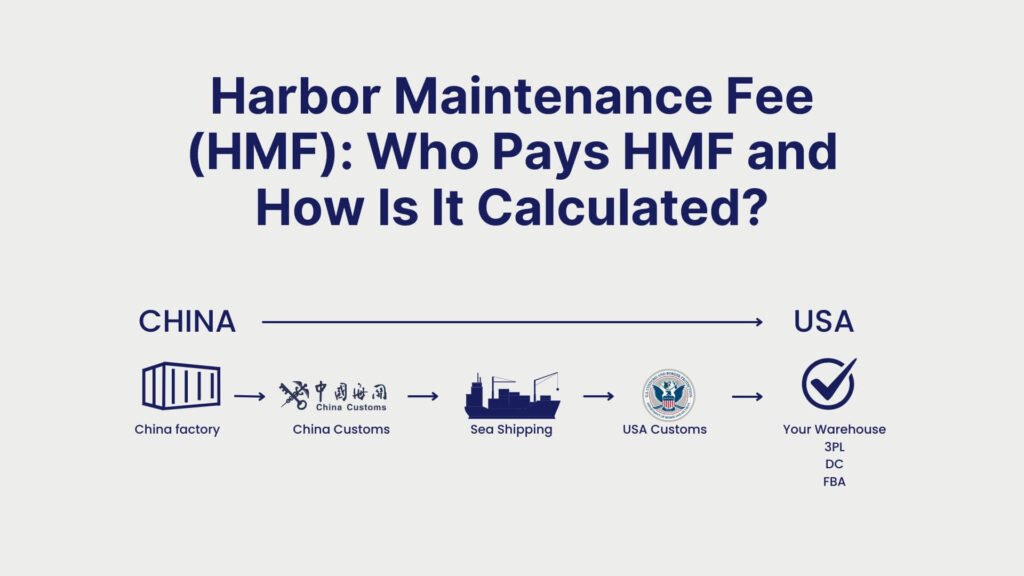
Confused by the Harbor Maintenance Fee on your import invoices? This surprise charge can hurt your budget. Let’s clarify who pays HMF and how it’s calculated for you.
The U.S. importer of record1 pays the Harbor Maintenance Fee (HMF)2. It is calculated as 0.125% of your cargo's declared value. This fee is collected by U.S. Customs and Border Protection (CBP)3 when your ocean shipment enters a U.S. port.
This fee is a small but important part of your import costs. But there's more to it than just a simple percentage. Let's break down the details so you can manage your imports with confidence. We'll start with what the HMF actually is.
What is the Harbor Maintenance Fee (HMF)2 and why does it apply to U.S. ocean imports?
Is the Harbor Maintenance Fee just another random charge on your bill? It can feel that way. But this fee has a specific purpose for maintaining the ports you use.
The Harbor Maintenance Fee (HMF)2 is a U.S. customs fee. It funds the maintenance and infrastructure of U.S. ports. It applies to imports entering via ocean and is calculated on cargo value, not weight or freight cost.

The Harbor Maintenance Fee isn't just a generic tax. It was created by the Water Resources Development Act of 19864. Its main job is to provide funds for the upkeep, maintenance, and development of U.S. harbors and channels. Think of it as a user fee for keeping the waterways deep and safe for large container ships.
HMF vs. Other Fees
It's easy to mix up HMF with other customs fees, especially the Merchandise Processing Fee (MPF)5. They are both collected by CBP, but they serve different purposes. The MPF covers the cost of processing your import entry paperwork. The HMF, on the other hand, is specifically for the physical port infrastructure.
Why It Matters to You
As an importer, I know that understanding this difference is important. It helps you see where your money is going. The HMF ensures the ports you rely on can handle modern cargo volumes efficiently, which ultimately benefits your supply chain by preventing delays and keeping goods moving.
Who pays the Harbor Maintenance Fee and when is it assessed during import clearance?
Unsure if you, your forwarder, or your supplier should pay the HMF? This common confusion can cause payment delays and friction. Let's clearly identify the responsible party.
The U.S. importer of record1 is responsible for paying the Harbor Maintenance Fee. The fee is assessed when your customs broker files the customs entry for your ocean import. It's collected by CBP alongside other import duties and fees.

The responsibility for the HMF falls squarely on the importer of record (IOR)6. In most cases, if you are the owner of the goods or the party causing the goods to be imported into the U.S., you are the IOR. It's not the responsibility of your overseas supplier, the ocean carrier, or even me as your freight forwarder, although a forwarder or customs broker will facilitate the payment on your behalf.
When is the Fee Due?
The HMF is assessed and becomes due at the time of customs entry filing. When I, as your customs broker, prepare the Entry Summary (CBP Form 7501)7 for your shipment, the HMF is calculated and included. The payment is then submitted to Customs and Border Protection (CBP) as part of the total duties and fees for that entry. It's not a separate bill you receive later. It’s an integrated part of the formal import clearance process, ensuring a smooth transition from port to your warehouse.
How is the Harbor Maintenance Fee calculated based on cargo value and entry type?
Worried you're calculating HMF incorrectly for your shipments? A small error can lead to overpayments or compliance issues. The formula is actually quite simple once you understand the basis.
HMF is calculated as 0.125% of the cargo’s declared customs value. This applies to formal consumption entries and other types like warehouse withdrawals. Importantly, it is based on the value of the goods, not including freight or insurance costs.

The calculation for the Harbor Maintenance Fee is direct and straightforward. The current rate is 0.125% of the value of the imported commercial cargo. This is the same as $1.25 for every $1,000 of value.
The Basis of Calculation: Entered Value
The key is what "value" is used. HMF is calculated on the entered value8 of your merchandise. This is the same value you declare to customs for duty purposes. It is crucial to note that this does not include costs like international freight, insurance, or other post-exportation charges. For a client like Mark, who is detail-oriented, this is a critical point for accurate cost forecasting. Misunderstanding this can lead to overpaying HMF by incorrectly including freight costs in the valuation.
Different Entry Types
The fee applies to most formal entries (Type 01). It also applies to goods admitted into a Foreign Trade Zone (FTZ)9 for consumption and withdrawals from a customs-bonded warehouse10 for consumption (Type 03). The calculation remains the same: 0.125% of the cargo's value at the time of entry or withdrawal.
Which shipments are exempt from HMF and what are common scenarios where importers overpay?
Do you assume HMF applies to every ocean import? You might be overpaying on certain shipments without realizing it. Knowing the specific exemptions is a direct way to save money.
HMF does not apply to exports, domestic shipments between U.S. ports, or cargo transiting through the U.S. to another country. Importers often overpay due to incorrect entry filing or not realizing that intra-port movements11 are exempt.

Not all cargo movements are subject to the Harbor Maintenance Fee. Understanding the exemptions is key to avoiding unnecessary costs. Many importers I work with are surprised to learn they have been overpaying for years.
Key HMF Exemptions
Here are the most common situations where HMF does not apply:
- Exports: Cargo loaded at a U.S. port for export to another country.
- Domestic Shipments: Cargo transported between ports within the mainland U.S. or to Alaska, Hawaii, or any U.S. possession.
- In-Bond Movements: Cargo moving under a customs bond through the U.S. for export to another country (e.g., from Canada to Mexico via the U.S.).
- Certain Government Cargo: Shipments for the Department of Defense.
Common Overpayment Scenarios
Overpayment usually happens due to simple errors. Here are a few I've seen:
| Scenario | The Mistake | How to Fix It |
|---|---|---|
| Incorrect Value | Including freight and insurance in the HMF base value. | Only use the customs value of the goods. |
| Wrong Entry Type | Filing a consumption entry for goods that should be in-bond. | Use the correct entry type for the movement. |
| Domestic Moves | Paying HMF on cargo moved from Hawaii to California. | Ensure your broker knows the cargo origin/destination. |
How does HMF appear on customs entries, invoices, and import documentation?
Do you struggle to locate the HMF charge on your import documents? It can be buried in a list of fees, making it impossible to verify. Here’s where to find it.
The Harbor Maintenance Fee is listed as a separate line item on the Customs Entry Summary (CBP Form 7501)7. Your customs broker's invoice should also show it clearly, often abbreviated as "HMF," allowing you to verify its accuracy.
For an importer like Mark who values details, knowing where to find and verify the HMF is essential. The fee isn't hidden, but you need to know where to look to maintain clear financial oversight.
On the Customs Entry Summary (CBP Form 7501)7
This is the official document filed with CBP. The HMF is clearly itemized here. You can typically find it in the "Summary of Duties, Taxes, and Fees" section. It will be labeled with CBP fee code 50112, and the calculated amount will be displayed. Reviewing this form gives you a direct confirmation of what was paid to customs on your behalf.
On Your Customs Broker's Invoice
As your broker, I make sure my invoices are transparent. You will see "Harbor Maintenance Fee" or the abbreviation "HMF" as a distinct line item. It will be separate from the Merchandise Processing Fee (MPF)5 and any duties. This transparency allows you to easily cross-reference the amount with your commercial invoice value13 and ensure the 0.125% rate was applied correctly. Always review these documents.
How can proper customs classification and entry planning help you manage HMF accurately?
Think HMF is just a fixed cost you can't control? While the rate is set, simple errors in your entry data can inflate the final amount you owe. Proper planning ensures accuracy.
Accurate customs valuation14 and correct entry filing are key to managing HMF. A knowledgeable customs broker helps ensure your cargo value is declared properly and the right entry type is used, preventing overpayments and ensuring full compliance with CBP regulations.

Managing the Harbor Maintenance Fee isn't about finding loopholes; it's about precision and accuracy. This is where a partnership with a reliable customs broker becomes invaluable for any serious importer.
The Role of Accurate Valuation
The HMF is directly tied to your cargo's customs value. If your commercial invoice is unclear or your valuation methodology is incorrect, you risk over-declaring value and therefore overpaying HMF. I work with my clients to ensure their declared value is correct and defensible, which in turn leads to an accurate HMF calculation. It’s a foundational step for cost control.
Strategic Entry Planning
How and when you enter your goods also matters. For example, if you don't need all your goods immediately, using a customs-bonded warehouse10 can defer HMF payment until you withdraw the goods for consumption. This type of strategic planning helps manage cash flow and ensures fees are paid only when necessary. It's about smart logistics, not just filing paperwork.
How does practical import guidance on HMF differ from simple glossary definitions?
Still have questions after reading official HMF definitions? These glossaries tell you what it is, but not how it impacts your daily operations. Let’s bridge that gap.
CBP glossaries15 define HMF, but practical guidance focuses on who pays, how it appears on invoices, where errors occur, and how importers can manage it. This operational focus helps you control costs and ensure compliance in your actual import transactions.

When you search online for HMF information, you'll find different types of content. Official sources provide definitions, while logistics blogs often offer basic explanations. However, for a U.S. importer, practical guidance that connects the fee to your actual business processes is most valuable. A simple definition doesn't help you verify an invoice or plan your logistics strategy. I've found that my clients, like Mark, need more than just a glossary term; they need actionable advice. This table breaks down the differences.
| Content Type | Strength | Limitation | Best Use Case |
|---|---|---|---|
| CBP Glossary Articles | Official, authoritative definitions | Limited operational detail | Regulatory reference & formal definitions |
| Incodocs-Style Blogs | Simple, easy-to-understand explanations | Minimal calculation depth or error scenarios | Introductory learning for new importers |
| End-to-End Import Guidance | Connects HMF to real-world accuracy & documents | Requires specific import expertise to apply | Active cost control & compliance management |
My goal is always to provide that end-to-end guidance, so you're not just informed, but also empowered to manage your imports effectively.
Conclusion
In summary, the HMF is a fee paid by the importer based on cargo value. Understanding its calculation, exemptions, and documentation helps you manage import costs and ensure compliance.
Knowing the responsibilities of the importer of record helps avoid payment delays and ensures proper fee management. ↩
Understanding the HMF is crucial for managing import costs and ensuring compliance with U.S. customs regulations. ↩
Understanding CBP's role helps importers navigate the customs process and manage fees effectively. ↩
This act established the HMF, making it vital to understand its historical context and purpose. ↩
Differentiating between MPF and HMF helps importers understand their specific purposes and avoid confusion. ↩
Clarifying the IOR's role ensures proper fee payment and compliance with customs regulations. ↩
Understanding this form helps importers verify fees and ensure accurate customs documentation. ↩
Accurate entered value is crucial for correct fee calculation and avoiding overpayments. ↩
Using an FTZ can defer HMF payments, aiding in cash flow management and strategic planning. ↩
Warehousing strategies can defer fees and optimize cash flow, making them valuable for importers. ↩
Understanding these movements helps avoid unnecessary HMF payments and manage costs. ↩
Recognizing this code helps importers identify and verify the HMF on customs documents. ↩
Accurate invoice values are essential for correct fee calculations and avoiding overpayments. ↩
Proper valuation ensures correct fee calculation and compliance, preventing costly errors. ↩
Glossaries offer official definitions, but practical guidance is needed for real-world application. ↩