Struggling with import paperwork1? The difference between a pro forma and a commercial invoice can cause costly delays. Understanding them is key to smooth shipping from China to the USA.
A Pro Forma Invoice2 is a preliminary bill of sale3 sent to buyers in advance of a shipment or delivery of goods. A Commercial Invoice4 is the final, official bill5. The main difference is their purpose: Pro Forma is an estimate, while the Commercial Invoice4 is a legal payment request.
Navigating international trade documents can feel complex. I see it all the time with my clients. But once you understand the role of each document, the entire process becomes much clearer. Let's break down these two critical invoices so you can manage your imports with confidence.
Understanding the Key Differences Between Pro Forma and Commercial Invoice4s?
Are you worried about using the wrong invoice? This can lead to customs problems6 and payment disputes7. Getting it right from the start saves you time, money, and headaches.
A Pro Forma Invoice2 is a non-binding estimate8 sent before goods are shipped, often for customs pre-clearance. A Commercial Invoice4 is a final, legally-binding document9 used for payment processing, customs clearance10, and accounting. The key difference is their purpose and legal standing.

Let's dive deeper into what sets these two documents apart. Think of the Pro Forma Invoice2 as a good faith quotation. It gives you, the importer, a clear idea of what to expect. It helps you arrange financing or apply for an import license. It is not a demand for payment. I often tell my clients that it's the "draft" version of the final bill.
The Commercial Invoice4, on the other hand, is the real deal. It is a legal document that serves as the official bill5 from the seller to the buyer. This is the document that US Customs and Border Protection (CBP) will use to determine the duties and taxes11 on your shipment. It must be accurate. As a customs broker12, I can tell you that any discrepancy between the commercial invoice and the actual goods can lead to significant delays and penalties.
Here is a simple table to show the main differences:
| Feature | Pro Forma Invoice2 | Commercial Invoice4 |
|---|---|---|
| Purpose | Quote, customs declaration | Payment request, official record |
| Legal Status | Not legally binding | Legally binding |
| Timing | Issued before shipment | Issued at the time of shipment |
| Accounting | Not used for accounting | Used for accounts payable/receivable |
| Payment | Not a demand for payment | A formal demand for payment |
When to Use a Pro Forma Invoice2 in International Trade?
Unsure when a pro forma invoice is necessary? Using it at the wrong time can complicate your shipment. Knowing its specific role helps you prepare your import logistics13 properly.
A Pro Forma Invoice2 is used when a seller needs to provide a potential buyer with a cost estimate before a final commercial invoice. It helps the buyer get financing, arrange customs clearance10, or calculate duties and taxes11 before the sale is final.
Let's look at the practical situations where a pro forma invoice becomes essential. I remember a client, Mark, who needed to secure a letter of credit from his bank to pay his supplier in China. The bank wouldn't approve the funds without a detailed document outlining the transaction. The final commercial invoice didn't exist yet because the goods weren't ready. So, the supplier sent a pro forma invoice. This document contained all the necessary details—description of goods, price, shipping terms—that the bank needed to see.
Another common use is for applying for import permits14 or licenses. Some goods require government approval before they can be imported into the USA. The authorities will ask for a pro forma invoice to understand the nature and value of the goods you intend to import. It's also incredibly useful for us as your logistics provider. When you send us a pro forma invoice, we can provide a more accurate quote for our ocean freight and customs broker12age services. It gives us the details we need to start planning your shipment from China.
How a Commercial Invoice4 Facilitates Customs Clearance and Shipping?
Is your container stuck at the port? An incorrect or incomplete commercial invoice is a common reason. This document is your passport through customs, so it must be perfect.
A Commercial Invoice4 is vital for customs clearance10. It details the sale, including product descriptions, value, shipping terms, and buyer/seller information. Customs authorities use this document to assess taxes, duties, and compliance, ensuring goods are processed smoothly across borders.
As a US customs broker12, the commercial invoice is one of the most important documents I work with. It tells the whole story of your shipment to the customs authorities. Think of a customs officer looking at your paperwork. They need to answer a few key questions very quickly: What is in the container? How much is it worth? Who is selling it? Who is buying it? The commercial invoice provides all these answers.
It must include very specific information. This includes the full name and address of both the shipper and the consignee. It needs a detailed description of the goods, not just a model number. For example, instead of "ABC-123," it should say "Men's Cotton T-Shirts." It also needs the quantity, the unit price, and the total value. The country of origin and the Harmonized System (HS) code15 for each product are also mandatory. Any mistake here can raise a red flag, leading to inspections, delays, and fines. Our customs broker12age service is designed to review these documents carefully to prevent such issues for our clients.
The Role of VAT in Pro Forma and Commercial Invoice4s?
Confused about how taxes appear on your invoices? VAT handling differs between pro forma and commercial invoices. Misunderstanding this can lead to accounting errors and tax compliance16 problems.
VAT (Value Added Tax) is usually not on a Pro Forma Invoice2 because it's not a final payment document. On a Commercial Invoice4, VAT is applied based on the sale value of the goods and is required for tax reporting by both buyer and seller.

Let's break this down. The pro forma invoice is an estimate. Since no sale has officially occurred, there is no tax liability yet. So, you typically won't see VAT or other sales taxes listed on it. It's a pre-transaction document. Its main job is to show the base cost of the goods and related charges like freight.
However, the commercial invoice is a legal sales document. It reflects the final, completed transaction. Therefore, it must include any applicable taxes, like VAT. The rules for VAT depend on the countries of the seller and buyer and the trade agreements between them. For a US importer, VAT isn't a direct concern since the US has a sales tax system, not a VAT system. But the commercial invoice's declared value is what US Customs uses to calculate import duties and taxes11. It's critical that the value is accurate. For your supplier, the commercial invoice is proof of export, which they may need for their own VAT refund purposes in their home country. This shows how the document is essential for tax compliance16 on both sides of the transaction.
Common Risks and Challenges with Pro Forma Invoice2s in Business Transactions?
Have you ever had a deal change after it started? Relying too much on a pro forma invoice can be risky. Prices and terms can change, leaving you in a difficult position.
Using a Pro Forma Invoice2 can create risks, like customs delays, because it's non-binding. Buyers may also have trouble with financing, as banks might not accept it as proof of a valid transaction. The lack of final terms can also lead to disputes.
The biggest risk with a pro forma invoice is that it is not set in stone. I once had a client who agreed to a price on a pro forma invoice. But by the time the goods were ready to ship, the supplier increased the price, citing higher material costs. Because the pro forma invoice is not a legally binding contract, my client had little power. He had to either accept the new price or cancel the order, which would have delayed his entire production schedule.
Another challenge is with customs. While a pro forma can be used for pre-clearance in some cases, some customs authorities may reject it and demand a final commercial invoice, delaying your shipment. Banks can also be strict. They may release preliminary funds based on a pro forma, but they will almost always require the official commercial invoice to finalize the payment, especially with a letter of credit. To avoid these issues, it is important to move to a formal sales contract and commercial invoice as quickly as possible. Clear communication with your supplier is key.
How Pro Forma and Commercial Invoice4s Impact Your Import Process?
Do you want a smoother import journey? Understanding how these two invoices work together is essential. Each one plays a specific role at a different stage of your shipment's journey.
Both Pro Forma and Commercial Invoice4s are vital to the import process17. The Pro Forma helps start the shipment and initial customs steps. The Commercial Invoice4 is essential for finalizing payment, ensuring tax compliance16, and securing the release of your goods from the port.

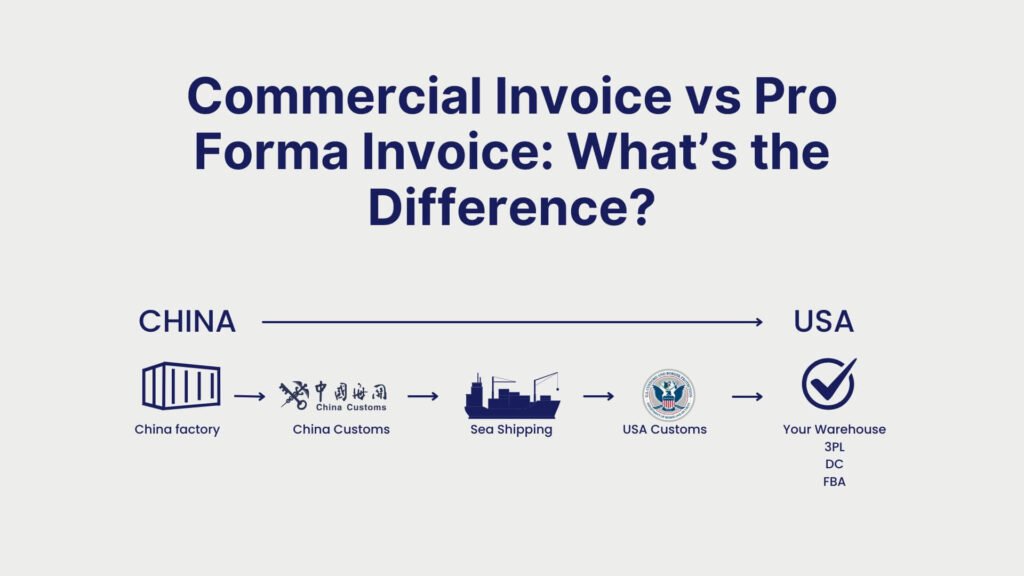
Let's walk through a typical import from China to the USA. The process begins with you, the importer, agreeing on a deal with your supplier. The supplier then sends a Pro Forma Invoice2. You use this document to open a letter of credit or to instruct us to book the ocean freight. We use the details on the PI to plan the container loading and sea transport.
Once the goods are manufactured and packed, the supplier creates the final Commercial Invoice4. This happens around the time the container is shipped. This document, along with the Bill of Lading and Packing List, forms the core set of shipping documents. When your container arrives in the USA, I use this Commercial Invoice4 as your customs broker12 to file the official import declaration with CBP. The invoice's accuracy is critical for calculating duties and ensuring a quick release. Without a proper Commercial Invoice4, your container will be stuck in customs. From booking freight to clearing customs, both invoices are indispensable tools for a successful import.
Conclusion
In short, the pro forma is your plan, and the commercial invoice is your proof. Mastering both is essential for smooth, cost-effective importing from China to the USA.
Understanding import paperwork is crucial to avoid costly delays and ensure smooth shipping from China to the USA. ↩
A Pro Forma Invoice is essential for customs pre-clearance and helps in arranging financing or import licenses. ↩
A preliminary bill of sale helps in planning and preparing for the final transaction. ↩
A Commercial Invoice is a legally-binding document crucial for payment processing and customs clearance. ↩
Understanding the official nature of a Commercial Invoice is key to its role in international trade. ↩
Avoiding customs problems is vital to prevent shipment delays and additional costs. ↩
Understanding invoice accuracy can prevent payment disputes and ensure smooth transactions. ↩
Knowing that a Pro Forma Invoice is non-binding helps in understanding its limitations in transactions. ↩
A Commercial Invoice's legal status is crucial for finalizing payments and ensuring compliance. ↩
A Commercial Invoice is vital for customs clearance, ensuring goods are processed smoothly across borders. ↩
Knowing how duties and taxes are calculated helps in accurate financial planning for imports. ↩
A customs broker ensures that all documents, including invoices, are accurate for smooth customs processing. ↩
Pro Forma Invoices provide essential details for planning and executing import logistics efficiently. ↩
Import permits are necessary for certain goods, and a Pro Forma Invoice aids in the application process. ↩
The HS code is crucial for determining duties and taxes, ensuring compliance with international trade laws. ↩
Invoices are crucial for ensuring tax compliance, avoiding penalties, and maintaining accurate records. ↩
Understanding the role of both invoices is essential for a smooth and efficient import process. ↩